
« In 10 years (2017–2026), France experienced 18 heatwaves. Over the previous 70 years, it had experienced 17. »
ACHED translation
Serge Zaka
agroclimatologist
2 July 2026
Hourly observations from the Paris Montsouris weather station on 26 and 27 June 2026.
Air temperatures naturally decrease as the evening progresses. When legal time is set two hours ahead of the sun (UTC+2), evening activities still take place during a warmer part of the day.
Hourly observations from the Paris Montsouris weather station on 26 and 27 June 2026 show that, at the same clock time, returning to the natural time zone corresponds to evening temperatures that can be up to nearly 4 °C lower.
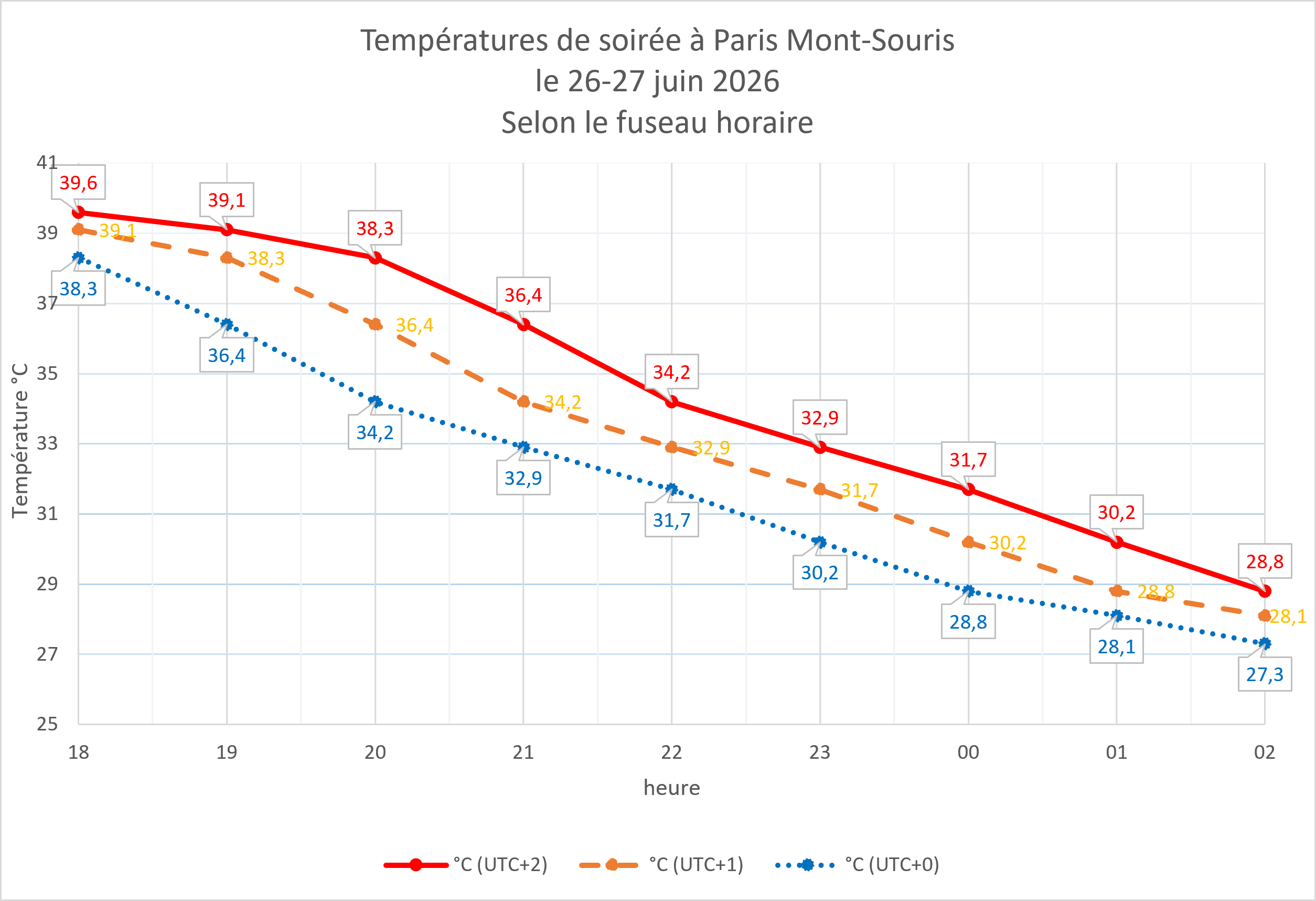
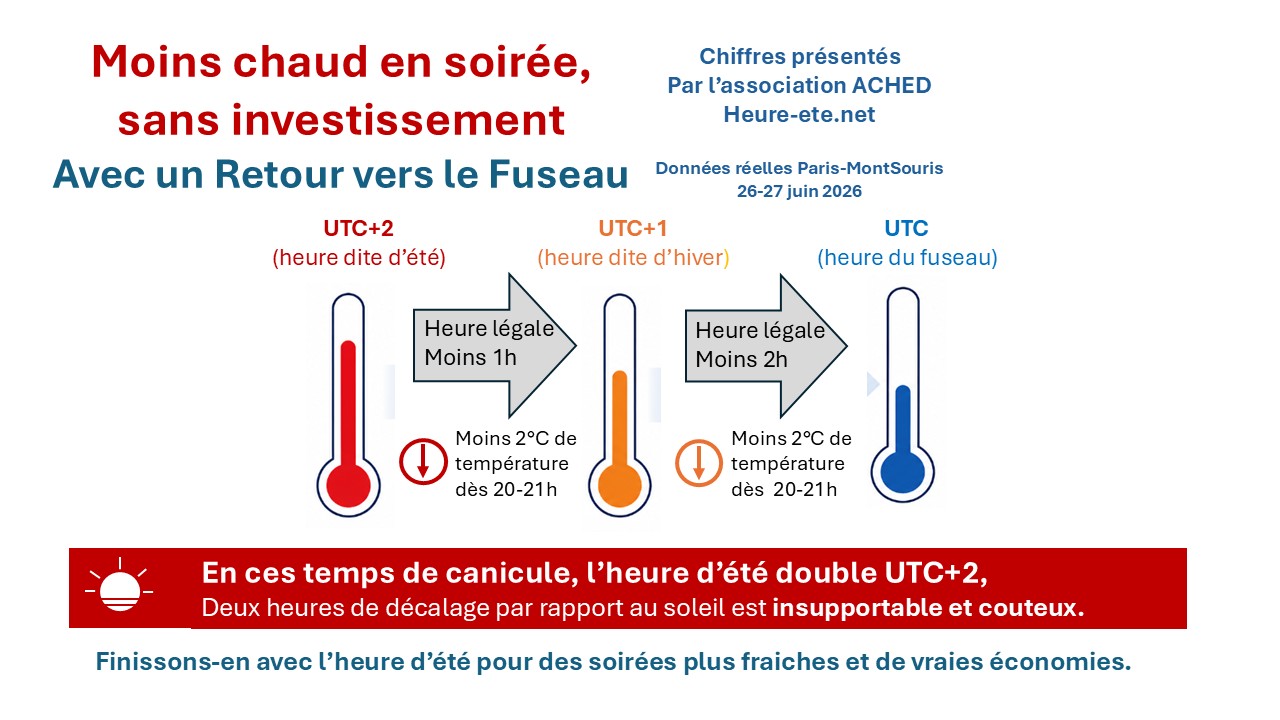
The data come from the Paris Montsouris weather station (Infoclimat) and cover 26 and 27 June 2026, at the height of the late June 2026 heatwave.
The late June 2026 heatwave was particularly intense. Heatwaves are nevertheless becoming more frequent and more severe as the climate changes. Returning to the natural time zone does not cool the air. It simply brings legal time closer to the position of the sun, allowing lower temperatures to occur earlier in the evening. Lower evening temperatures make it possible to ventilate homes earlier, reduce the need for air conditioning and promote better sleep.
Double summer time is often said to have been introduced in 1976 to save energy. Since then, quantitative evidence supporting these energy savings has remained limited. In 2010, with regard to residential air conditioning, ADEME anticipated that summer time could instead increase cooling demand.
ADEME reiterated this conclusion at least as early as 2014 in a communication published after its 2010 report. To date, we have not found any communication released when that report was published. It is therefore not possible to determine whether this text was written in 2014 or whether it is a republication of an earlier communication. The 2014 communication no longer appears to be available on ADEME's website. We therefore provide a copy preserved by Internet Archive so that this reference remains accessible regardless of its availability on the ADEME website.
View the archived ADEME press release ↗
For its part, ACHED considers that summer time increases carbon emissions and therefore contributes to global warming.
About the term 'perceived heat'. We use this expression because many people in France genuinely experienced these hot evenings, and several testimonies explicitly linked them to summer time. This perception is entirely legitimate, and we hope the weather observations presented here help explain why. It reflects a measurable situation: at the same clock time, evening activities take place when the air temperature is higher. It is therefore not merely a subjective impression, but the observable consequence of the gap between legal time and the position of the sun.
A few useful references to place this page in the context of heatwaves, climate change and legal time.
« In 10 years (2017–2026), France experienced 18 heatwaves. Over the previous 70 years, it had experienced 17. »
ACHED translation
Serge Zaka
agroclimatologist
Published on:
July 2, 2026
Last update:
July 12, 2026